



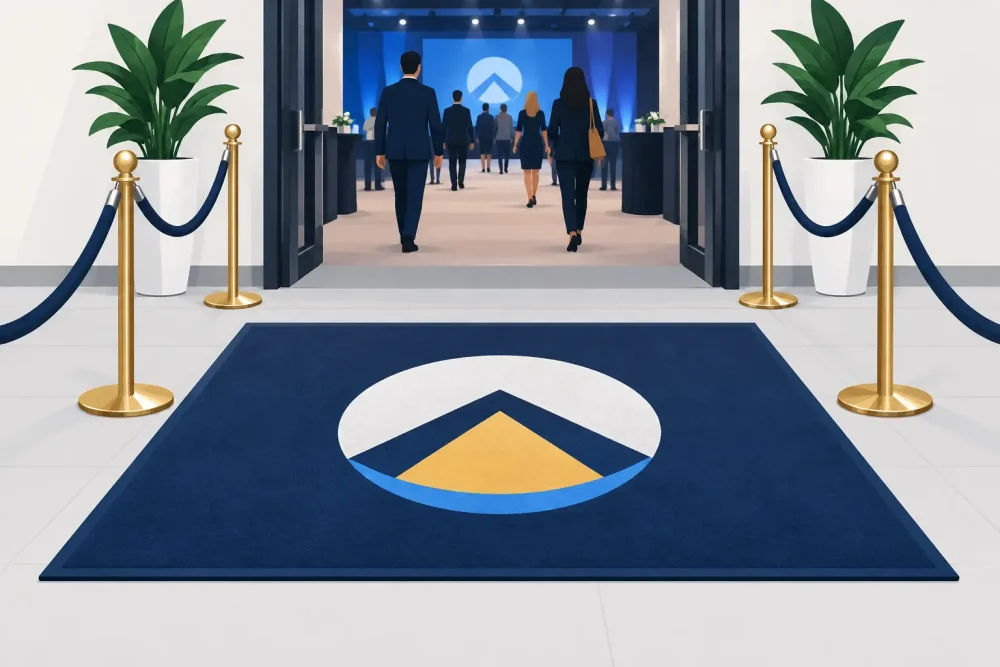
A guest may not remember every sign in a busy venue, but they will remember the path that made them feel like they had arrived somewhere special. Custom logo rugs for events turn an ordinary entrance, aisle, or activation footprint into a branded first impression – one that works in photographs, guides movement, and gives the entire space a more intentional finish.
For a wedding, that might mean a monogrammed ceremony runner that frames the walk down the aisle. For a corporate event, it can mean a full-color logo rug at registration or a runway-style branded carpet that gives a product launch its own visual territory. The strongest projects balance the creative idea with practical choices about size, placement, material, installation, and timing.
Why Custom Logo Rugs for Events Make an Impact
Floor space is one of the most visible and least wasted branding opportunities at an event. Guests look down as they enter, line up, walk to their seats, and pose for photos. A custom rug puts your identity exactly where the experience begins without crowding walls with additional signage.
It also helps create a clear sense of arrival. A logo at the entrance tells attendees they are in the right place. A branded runner leading to a stage, sponsor lounge, or photo moment directs traffic with more polish than temporary signs alone. At a gala or awards event, a logo rug can deliver the red-carpet feeling guests expect while giving photographers a consistent branded backdrop beneath every shot.
The effect is not limited to logos. Event flooring can carry a step-and-repeat-inspired pattern, a wedding crest, a campaign graphic, a hashtag, a mascot, or an edge-to-edge illustration. The best design depends on how close guests will be to the rug and how it will be photographed. A small mark that looks sharp on a digital proof may disappear in a wide event photo, while oversized artwork can feel crowded in an intimate ceremony space.
Start With the Guest Journey, Not the Artwork
Before selecting colors or uploading a logo file, map how people will move through the space. Identify the arrival point, check-in area, primary aisle, photo zone, stage approach, and exit route. This reveals where a rug will create the most value rather than simply fill open floor.
An entrance rug works best when it begins where guests naturally slow down. If attendees will queue at registration, allow enough clear floor space for lines, stanchions, and accessible passage. For a ceremony runner, measure from the first row to the altar or focal point and account for turns, platforms, and any décor that will overlap the edges.
Placement should also account for the camera angle. A rug may be viewed from above, from the end of an aisle, or from across a crowded ballroom. Orient logos toward the most important photo position and avoid placing vital copy where people will stand for long periods. If the rug is a sponsor asset, confirm logo orientation and visibility requirements before production starts.
Choose Dimensions That Feel Intentional
A rug that is too narrow can make a grand entrance feel undersized. One that is too wide may interfere with guest seating, door clearance, or booth layouts. The right proportion depends on the room and the role of the flooring.
For a ceremony aisle, the runner should give the wedding party comfortable walking space without overpowering floral arrangements or chairs. For a retail-style activation or fashion show, a wider branded path can establish a stronger visual boundary and make the area feel more immersive. Long corridors often benefit from a continuous runner, while large open rooms may be better served by a centered logo rug or several coordinated zones.
Custom sizing is especially useful when standard dimensions leave an awkward gap or require excessive trimming. Measure the finished usable area, not just the room dimensions. Include door swings, columns, staging, furniture, and any location where flooring must stop for safety or venue access.
Design for Print, Foot Traffic, and Photography
Custom artwork needs to do three jobs at once: look right in person, reproduce cleanly on the rug, and remain recognizable on camera. That calls for more restraint than many first drafts receive.
Use high-resolution artwork whenever possible. Vector logo files are ideal because they preserve clean edges when scaled up. If a raster image is the only available option, it should be large enough for the final rug dimensions. A low-resolution social media graphic can look acceptable on a screen but become soft or pixelated across an event floor.
Keep fine text and thin lines to a minimum. They can lose clarity in carpet fibers, especially when viewed from a distance. Strong type, simple shapes, generous spacing, and high-contrast color combinations usually perform better. If your brand palette includes subtle tonal differences, request a proof and discuss Pantone matching for projects where color accuracy is central to the campaign.
White and very light rugs create a striking formal look, but they show scuffs and outdoor debris more quickly. Deep colors can hide traffic marks, though very dark graphics on dark carpet may photograph with less definition. There is no universal best color choice. A white wedding aisle runner and a charcoal product-launch carpet solve different visual and operational needs.
Select a Material for the Venue Conditions
Indoor ballroom flooring, a covered tent, a sidewalk, and a grass lawn all present different conditions. Material selection should begin with where the rug will be used, how long it will remain in place, and the amount of foot traffic it will receive.
For indoor events, a carpet-style runner can add softness, color, and a refined finish over hard flooring. It is a natural choice for ceremonies, galas, premieres, trade show areas, and fashion presentations. Outdoor use may call for a more weather-tolerant solution, such as turf-style runners or materials suited to temporary exterior walkways.
Weather matters even for partially covered events. Moisture, wind, dirt, uneven pavement, and grass can affect both appearance and stability. If rain is possible, develop a backup plan that includes protected storage before installation and a clear decision point for moving the rug indoors or adjusting the layout.
Venue rules matter just as much. Ask whether the facility allows adhesive products, whether flame ratings are required, and whether loading dock or elevator dimensions limit how large a rolled rug can be. A beautiful custom piece cannot do its job if it arrives too late to fit through the service entrance.
Plan Installation as Part of the Design
A logo rug should lie flat, stay in position, and look finished at the edges. That requires the right securing method for the surface beneath it. Installation tape and other temporary flooring accessories are not afterthoughts. They help reduce shifting, curling, and trip hazards during high-traffic moments.
The appropriate tape depends on whether the rug is being installed over carpet, concrete, wood, tile, or another surface. Test any adhesive approach when venue flooring is sensitive, and follow the venue’s removal requirements. For outdoor placement, consider wind exposure and the condition of the ground. A rug laid over uneven terrain may need a different location or added preparation to create a safe walking surface.
Build installation time into the event schedule. Large pieces need room to unroll, position, and secure before guests arrive. Coordinate with decorators, florists, staging crews, photographers, and audiovisual teams so the rug is not covered by equipment or damaged during load-in. Taking a few setup photos before the doors open also gives your team a clean record of the finished branded environment.
Give Custom Production Enough Lead Time
Custom rugs are made around your dimensions, artwork, colors, and event specifications, so they require more planning than an in-stock aisle runner. Begin the conversation as soon as the venue and event footprint are reasonably confirmed. This leaves time for artwork review, proof approval, production, shipping, and a buffer for changes.
Fast shipping can be valuable for eligible standard products, but a complex branded rug should not be treated as a last-minute print job. Large-format graphics, unusually shaped cuts, multiple logos, and color-matching requirements all benefit from early decisions. If your event date is approaching, prioritize the nonnegotiables: final dimensions, approved artwork, delivery address, and installation plan.
Event Rugs can support projects ranging from a custom wedding monogram to a large-scale corporate activation, with practical accessories available to help secure the finished installation. A clear quote request should include the event date, venue location, desired dimensions, surface type, artwork, and whether the rug will be used indoors or outdoors.
A custom logo rug is more than a decorative detail. It is a physical invitation to step into your brand, your celebration, or your story. Give it a defined purpose, a practical installation plan, and artwork built for the scale of the room, and every step will make the statement you intended.