



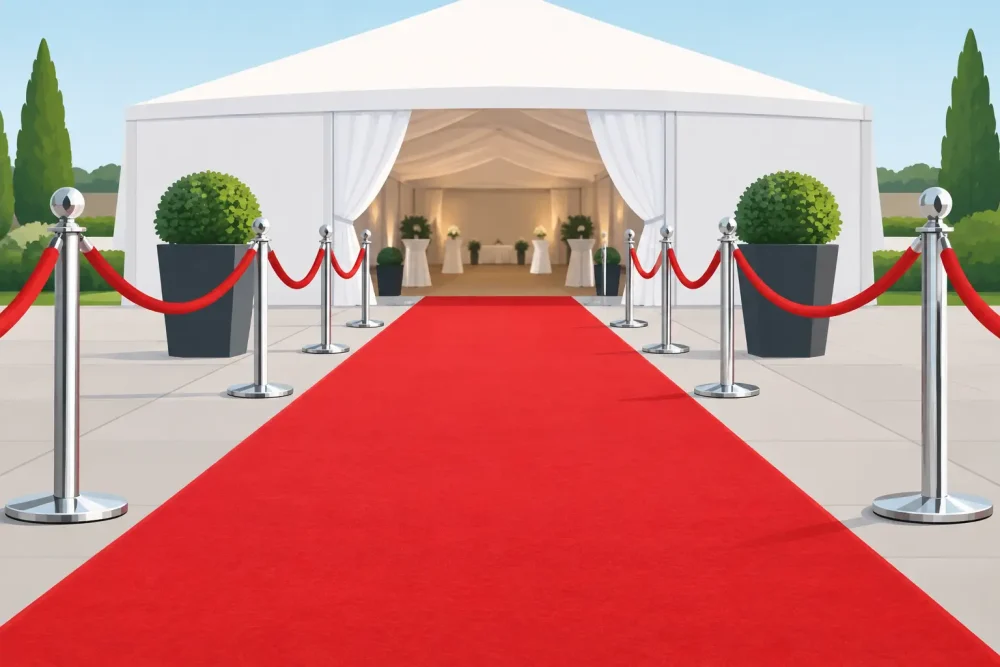
A venue entrance can look finished or improvised in the first ten feet. Bare concrete, uneven grass, worn flooring, and long corridors all change how guests approach an event. The right temporary walkway carpet for events gives that arrival a clear purpose: it directs traffic, supports the design, protects the surface below, and creates a photo-ready path from the first step.
For a wedding ceremony, that may mean a clean white aisle runner against green grass. For a gala, it may be a bold red carpet that gives guests a fit-for-the-stars arrival. For a corporate activation, it can be a logo-branded walkway that carries the campaign beyond the step-and-repeat. The best choice is not simply the most dramatic color. It is the carpet that suits the location, guest volume, weather, installation window, and visual story of the event.
Start With the Path Guests Will Actually Take
Before choosing material, measure the full guest journey. That includes more than the ceremonial aisle or front-door threshold. Consider the route from valet drop-off to entrance, lobby to ballroom, backstage to runway, or tent opening to ceremony seating. A short runner can define a focal point beautifully, but an undersized walkway can leave guests stepping off the carpet before the intended moment is complete.
Width matters as much as length. A narrow runner may be appropriate for a single-file ceremony aisle or a decorative photo moment. A wider carpet creates a more generous experience for couples walking side by side, VIP arrivals, fashion models, camera crews, or guests entering in groups. If the path will also accommodate wheelchairs, strollers, or service carts, plan extra room rather than treating the walkway as a purely decorative feature.
Account for the surroundings, too. A runner that looks substantial in a small chapel may appear lost in a hotel ballroom or across an open lawn. For large-scale spaces, wider dimensions, border treatments, or a custom-cut layout can give the walkway the visual presence it needs.
Choose Material for the Venue, Not Just the Color
A temporary carpet has to perform under real event conditions. Indoor ballroom flooring, outdoor turf, concrete, sand, and uneven pavers each create different installation needs. The right material depends on whether the priority is softness underfoot, weather tolerance, clean branding, surface protection, or fast removal.
Standard event carpet is a versatile choice for ceremonies, galas, premieres, retail moments, and indoor activations. It creates a polished runway-like finish and is available in colors that can complement everything from black-tie styling to a vivid product launch palette. For high-visibility arrivals, rich red, black, white, navy, and custom colors each create a different mood in photographs.
Outdoor settings call for closer attention. Turf grass runners can bring a refined lawn effect to patios, rooftops, trade-show spaces, and brand environments where natural greenery is not practical. Carpet can also work outdoors, but it should be selected with the expected foot traffic and weather exposure in mind. A light-colored runner after rain or on muddy ground may require more preparation than it is worth. In those conditions, a darker color, a protected route, or a material designed for the setting is usually the smarter production decision.
For a custom event floor, consider how the material will photograph. Plush texture can feel elevated, while a flatter surface may reproduce logos and graphics more clearly. Samples and color review are especially valuable when the carpet must coordinate with florals, drape, stage lighting, or a brand’s approved palette.
Temporary Walkway Carpet for Events Needs a Secure Install
Even a beautiful runner can become a distraction if the edges curl, shift, or buckle. Securing the walkway is not an optional finishing detail. It is part of the guest experience and the event’s safety plan.
Start with a clean, dry surface whenever possible. Dust, moisture, loose gravel, and textured flooring can affect how well tape adheres. Roll out the carpet in the direction of travel, let it relax flat, and inspect the full length before guests arrive. Avoid stretching the material tightly, which can encourage rippling as temperatures change or as foot traffic builds.
Installation tape should match the surface and the removal requirements. A temporary adhesive solution may be ideal for a one-night event, while sensitive venue flooring may call for a method designed to minimize residue. Outdoors, wind exposure and uneven ground often require additional attention at edges, seams, and transitions. If the walkway crosses thresholds, cords, ramps, or changes in elevation, address those points before doors open.
For a long corridor or a multi-piece installation, seams deserve the same care as perimeter edges. Align the grain and color direction, keep joins tight, and secure them from underneath or with an appropriate finishing approach. A visibly separated seam can interrupt both photos and foot traffic.
Match the Design to the Event’s Job
Walkway carpet is often treated as decor, but it can solve several design problems at once. It can establish hierarchy by showing guests where to enter, where to gather, and where the main experience begins. It can also create separation in an open venue, turning a broad warehouse floor or outdoor expanse into a deliberate event environment.
For weddings, the carpet should support the ceremony rather than compete with it. Neutral runners work well when florals, scenery, or architecture are the feature. A colored aisle can make a stronger statement in a minimal room or provide contrast against a pale floor. If petals, candlelight, or chairs will line the path, leave enough visible carpet around them for the aisle to still read clearly in photos.
For corporate events and brand activations, the walkway can become a branding surface. Custom logo rugs, printed graphics, Pantone-matched colors, and shaped cut-outs give a campaign a physical footprint. This is especially effective at entrances, product reveal zones, media walls, and experiential stations where attendees will naturally pause for photos. Keep the message simple enough to read from standing height and from a camera angle. A logo that is too small or crowded by surrounding decor will not deliver the impact the project deserves.
Fashion shows, award events, and premiere-style arrivals often call for a more theatrical approach. The carpet can extend from the exterior entrance through check-in and into the main room, creating one continuous visual cue. In these settings, consistency matters. A red carpet moment loses some of its effect when the runner, barricades, lighting, and signage tell different stories.
Plan for Volume, Timing, and Cleanup
An event carpet may only be down for a few hours, but those hours can be demanding. Consider the number of guests, footwear, rolling equipment, food and beverage service, and whether the walkway will be used before, during, and after the main program. A ceremony aisle with 100 guests has different needs than an all-day convention entrance with thousands of attendees.
Choose a color with the expected traffic in mind. White and ivory create a striking wedding look, but they show marks quickly in public entry areas. Deep colors can be more forgiving for high-volume events, while patterned or branded designs may help disguise minor wear. If a pale runner is essential, protect it until the final installation window and limit unnecessary traffic before the event begins.
Delivery timing should be part of the flooring plan from the start. Standard-size runners can be a practical solution for fast-moving timelines, while custom dimensions, specialty shapes, branded graphics, and matched colors require production lead time. Confirm venue delivery rules, receiving hours, freight access, and storage space before placing a large order. A perfectly designed carpet cannot help if it arrives when the venue dock is closed.
It also helps to assign ownership. One person should be responsible for inspecting the carpet at delivery, confirming measurements, overseeing installation, and approving the final walk-through. For a major production, that may be the event manager, floor manager, or installation crew. For a wedding, it may be a planner, venue coordinator, or trusted member of the setup team.
When Standard Sizes Work and When Custom Is Worth It
Ready-to-order runners are a strong choice when the dimensions are straightforward, the event timeline is tight, and the design calls for a classic aisle or entrance treatment. They offer speed, simplicity, and a dependable visual result without adding unnecessary complexity to the planning process.
Custom is worth considering when the space has unusual dimensions, the route turns corners, the event needs a precise color match, or the carpet itself is central to the brand experience. A custom rug can be produced for a specific entrance, runway, display zone, or ceremony layout instead of forcing the event design to fit a standard roll. Event Rugs supports both approaches, from accessible aisle runners to custom flooring built for high-impact installations.
The trade-off is planning. Custom work gives you more control over size, shape, color, and graphics, but it requires clear measurements, approved artwork, and enough lead time for production and delivery. When the walkway will be photographed, broadcast, or seen by VIP guests, that extra preparation is often what separates a good-looking event from a fully resolved one.
A temporary walkway should feel effortless to guests. They should see the path, trust their footing, and experience the intended atmosphere before they reach the main event. When the material, scale, installation, and design all work together, every step makes a statement without asking for attention.