



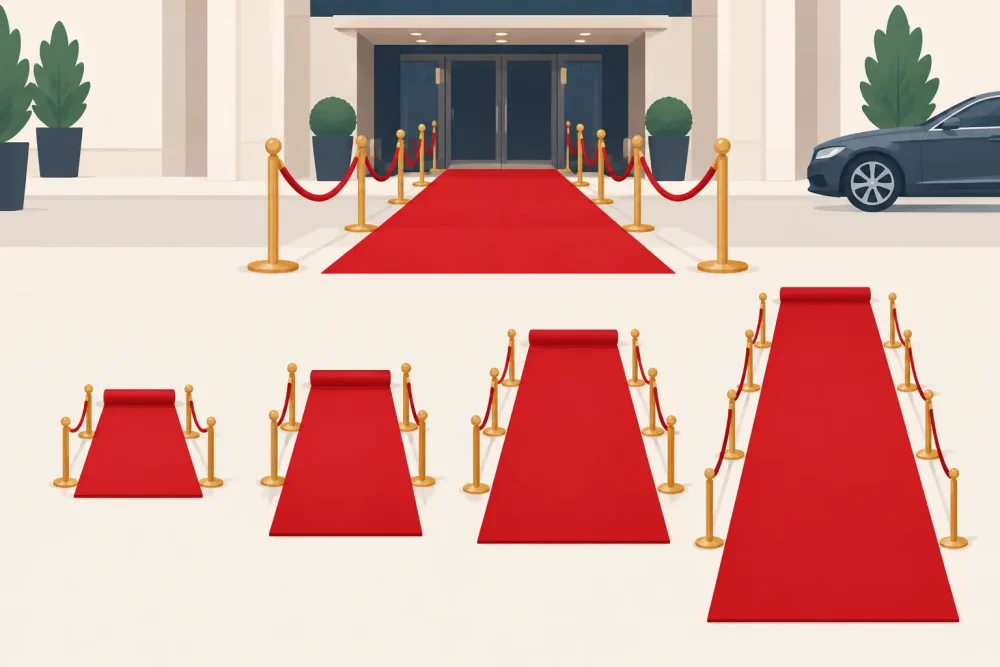
A red carpet that ends too soon makes an entrance feel unfinished. One that is too narrow forces guests to walk single file, while one that is oversized can create unnecessary cost, seams, and installation work. If you are asking what size red carpet is needed for your event, the answer starts with the space, the number of people using it, and the moment you want it to create.
For a private wedding, a 3-foot-wide runner may be exactly right. For a gala arrival with photographers and paired guests, a 6-foot or wider carpet creates the presence people expect. The best size is not simply the largest carpet that fits. It is the one that gives guests a comfortable route, supports the camera angle, and looks intentional from the first step to the final photo.
What Size Red Carpet Is Needed? Start With the Route
Measure the full walking route, not just the visible doorway or aisle. Include the point where guests first step onto the carpet and the place where they naturally stop, pose, turn, or enter the main event space. A carpet that begins 2 to 4 feet before the entrance creates a proper arrival moment rather than an abrupt transition at the door.
For length, add a little visual breathing room at both ends. If the measured walkway is 20 feet, a 24- to 25-foot runner often looks more polished. This extra length is especially useful when a stanchion line, floral arrangement, step-and-repeat, or welcome sign changes where people begin walking.
Width depends on traffic and purpose. A 2-foot-wide red carpet works well for a narrow ceremony aisle or a decorative path where one person walks at a time. A 3-foot width is a classic choice for weddings, small entrances, and VIP walkways. Choose 4 feet when guests will pass one another or couples will walk side by side. For premieres, award-style arrivals, corporate galas, and high-traffic photo moments, 6 feet is a strong starting point. Larger productions may call for 8, 10, or 12 feet wide, particularly when photographers, hosts, and talent need room to move.
Match Carpet Width to the Guest Experience
A red carpet is part of your event flow. It should guide people without becoming a bottleneck. Think about who will use it and how they will move.
At a ceremony, the runner needs to frame the processional. A 3-foot-wide aisle runner generally gives a wedding party enough room to walk comfortably while leaving space for chairs, florals, or ceremony décor. If a parent is escorting someone down the aisle, 4 feet can feel more generous and photograph better.
At an entrance, guest behavior changes. People arrive in pairs, pause to greet others, and may be directed toward a photo backdrop. A 4- to 6-foot carpet gives the space a more welcoming feel and prevents the arrival line from feeling cramped. If you expect a high volume of guests in a short arrival window, prioritize width over a longer route.
For a branded event, the carpet may need to accommodate more than foot traffic. Consider where media, lighting, step-and-repeat photography, product displays, or security will sit. The carpet should remain the visual focus without placing guests so close to the backdrop that photos feel crowded. A wider custom carpet can also carry a logo, repeating graphic, or Pantone-matched brand color with far greater impact than a narrow standard runner.
Common Red Carpet Size Starting Points
These dimensions are reliable starting points, but venue layout should always have the final word:
- A small ceremony aisle: 3 feet wide by 25 to 50 feet long.
- A wedding or party entrance: 3 to 4 feet wide by 10 to 30 feet long.
- A gala or corporate arrival: 4 to 6 feet wide by 20 to 50 feet long.
- A photo call or premiere-style walkway: 6 to 10 feet wide by 20 to 60 feet long.
- A runway, stage approach, or large activation: custom width and length based on the floor plan.
If your space is unusually wide, do not assume a single standard runner must fill it. A centered carpet with intentional open floor on either side can look elegant. On the other hand, if the carpet is meant to transform a plain lobby or warehouse floor, a wider custom configuration may deliver the dramatic effect the event needs.
Plan for Photos, Furniture, and Floor Conditions
The camera sees more than the route. Before ordering, stand where photographers and guests will stand, then look through a phone camera. A carpet that appears substantial in person can look narrow when flanked by large walls, tall doors, or oversized décor. This is one reason red carpet events often benefit from 6-foot widths or more.
Also account for furniture and architectural details. Measure around door swings, registration tables, flower arrangements, columns, ramps, and queue barriers. Leave enough clearance for guests using mobility devices and for venue staff who may need to access the area during the event.
Floor surface matters as well. Indoor carpet runners typically need tape or another appropriate securing method so edges stay flat and safe. Outdoor use may require a heavier material, additional fastening, or a layout that avoids standing water and uneven ground. Grass, pavers, concrete, ballroom flooring, and temporary event decking each create different installation considerations.
Never trim a few inches from your measurements just to avoid ordering a larger size. A carpet that is slightly too short cannot be stretched, and an undersized width is immediately noticeable. When the exact dimensions are not available as a standard size, a custom runner is usually the cleaner solution.
When Standard Sizes Work and When to Go Custom
Standard red carpet runners are ideal when your route is simple, timing is tight, and a conventional width suits the space. They are a practical choice for wedding aisles, school events, retail openings, home celebrations, and straightforward venue entrances. With eligible products available for fast shipping, they can be particularly helpful for events working on a compressed schedule.
Custom carpeting becomes worthwhile when the event has a specific visual or operational requirement. That could mean an extra-wide arrival path, a runner cut around a stage, a curved walkway, a precise color match, or a branded logo treatment. Custom work also makes sense when multiple carpet sections must align across a larger footprint.
For large-scale productions, ordering one continuous piece can reduce visible seams and create a stronger camera-ready finish. Still, it may not be the best choice for every venue. Elevators, loading docks, door widths, and installation access can limit how large a rolled carpet can be handled. In those cases, planned sections with carefully placed seams may be the more practical production decision.
A Simple Measuring Method Before You Order
Use a tape measure to record the route length and width at several points, not just one. Buildings are rarely as square as they appear. Write down the narrowest usable width, the location of doors and furniture, and the distance from the carpet edge to walls or seating.
Then mark the footprint with painter’s tape, kraft paper, or a temporary line on the floor when permitted. Walk it as a guest would. Have two people stand side by side. Take a photo from the main arrival angle. This quick test reveals whether the width feels premium, whether the route is long enough, and whether the carpet needs to shift for a better visual line.
If there is any uncertainty, share the measurements and event plan with a flooring specialist before placing the order. Event Rugs can help translate a floor plan into a runner size that looks fit for the stars while remaining practical to install.
The right red carpet size should make guests feel like they have arrived somewhere special before anyone says a word. Measure generously, plan for the camera, and let every step make the statement your event deserves.